

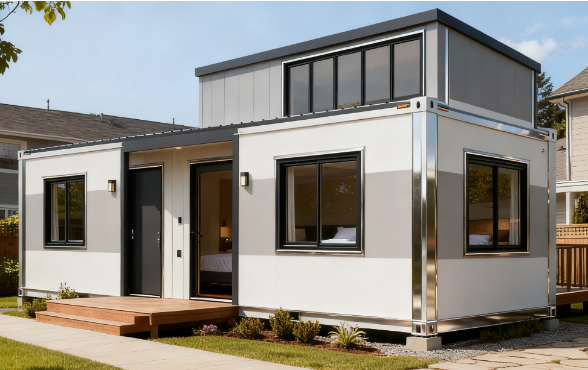
Introduction: At the Crossroads of Paradigm Shift in Residential Development
A silent revolution is underway in today’s construction and development sector. Land costs have climbed to historic highs, building material prices fluctuate dramatically, skilled labor is increasingly scarce, and market demand for high-quality, sustainable, and rapidly occupiable housing continues to grow. Facing these multiple pressures, astute project decision-makers are seeking innovative solutions that balance efficiency, cost, and quality. Among these, the two-bedroom container house is evolving from an alternative choice into a strategic asset, offering a predictable, sustainable, and cost-effective construction pathway for development projects of all scales.
The two-bedroom container house system is based on sea-proven steel structural modules. Through industrialized precision manufacturing and rapid on-site assembly, it brings unprecedented certainty to development cycles, budget control, and design innovation. This article will delve into how this building system creates comprehensive competitive advantages for residential projects, from financial models to design language, from construction processes to long-term value propositions.
I.Efficiency Reimagined: How industrialized production compresses the project critical path;
In traditional development models, time is not just money—it’s opportunity cost. A typical project containing 20 residential units often requires a 24-30 month construction cycle from design completion to key handover. Over 65% of this time is consumed by unpredictable on-site work—weather delays, material shortages, process conflicts, and labor efficiency fluctuations— all creating immense uncertainty in project timelines.
The two-bedroom container house system fundamentally restructures this time logic. By transferring over 80% of construction activities from the job site to controlled factory environments, project timelines achieve critical optimization:
Parallel Engineering Model:
While land is being graded and foundations constructed, complete modules of two-bedroom container houses are simultaneously produced in factories. This separated yet synchronized workflow can shorten overall project cycles by 40-60%. For projects requiring rapid response to market changes or with strict time windows, this time certainty holds significant commercial value.
Installation Speed Revolution:
On-site installation of a complete two-bedroom container house unit requires only 1-3 days—including structural positioning, module connection, and external sealing. In contrast, traditional on-site construction of comparable units requires 3-4 weeks. In a medium-scale development project, this time compression can more than double capital turnover speed.
Seasonal Risk Avoidance:
Factory environments are unaffected by weather conditions, meaning projects can proceed as scheduled without buffer time reserved for rainy seasons, extreme cold, or high temperatures. For regions with complex climate conditions or limited construction seasons, the two-bedroom container house system provides year-round continuous production capability.
II. Cost Structure Transformation: From Variable Expenditure to Fixed Investment
Budget overruns in development are the norm, not the exception. According to industry data, traditional residential projects average 18-25% over budget, with major overruns concentrated in the on-site construction phase—which accounts for 60-70% of direct costs yet is the most difficult to predict and control.
The two-bedroom container house system, through industrialized prefabrication, transforms most costs from “variables” to “constants”:
Scale Benefits in Material Procurement:
Centralized factory purchasing reduces key building material costs by 8-15%. Bulk ordering of steel components, insulation materials, window and door systems, and interior finishes not only achieves pricing advantages but ensures quality consistency and supply stability. For a project containing 30 two-bedroom container house units, material costs alone could save $150,000-$250,000.
Industrialized Enhancement of Labor Efficiency:
Specialized assembly lines increase labor productivity by 40-60%. In factory environments, workers can focus on specific processes, developing muscle memory and professional skills that minimize error rates. Simultaneously, stable factory employment reduces staff turnover, further ensuring consistency in craftsmanship quality.
Precision Building for Waste Minimization:
Through digital modeling and precision manufacturing, material waste rates for two-bedroom container houses drop from 15-20% at traditional sites to 3-5%. Each ton of construction waste avoided not only saves material costs but also eliminates waste disposal fees and environmental compliance costs.
Temporal Optimization of Financial Costs:
Shortened construction cycles directly reduce interest expenses on development loans. A traditional project might require 18 months of construction financing, while a comparable-scale two-bedroom container house project might need only 9-12 months. This time differential is particularly valuable in a rising interest rate environment.
III. Design Strategy: Customized Expression of Standardized Modules
Architectural value lies not only in shelter but in spatial experience and aesthetic expression. The two-bedroom container house system finds an exquisite balance between standardized efficiency and personalized design:
Grammar System of Module Combinations:
The single two-bedroom container house module is a standardized product unit, but its combination method forms a rich architectural vocabulary. Through juxtaposition, stacking offset and, even using the same basic module, a variety of architectural groups can be created. This design concept of “limited module, infinite combination” enables the project to achieve placemaking expression while maintaining industrial efficiency.
Multi-Layered Strategy for Facade Systems:
The exterior treatment of two-bedroom container houses offers multiple choices from industrial authenticity to complete concealment. Preserving the original corrugated steel panel appearance with modern color schemes can create distinct industrial aesthetics; while adding wooden cladding, metal panels, or composite hanging systems can allow seamless integration into traditional community fabrics. This flexibility enables the same product to adapt to diverse scenarios from urban renewal to rural development.
Functional Adaptability of Interior Spaces:
The standard interior configuration of a two-bedroom container home can be differentiated to suit the target tenant or buyer group. Units aimed at young professionals might feature open-plan workspaces; those for small families could enhance storage and child safety features; and age-friendly units could incorporate accessible facilities and health monitoring systems. This approach ofstandardized shell, customized core” allows the project to meet the specific needs of niche markets precisely.
Spatial Creation at Community Scale:
Through the clever arrangement of container house modules with two bedrooms, the project can naturally form courtyards, alleys, shared gardens and community centers. Mod construction not only creates living space, but also defines external community relationships through its combination logic. This dimension of scale transformation from unit to community is one of the most innovative values of the building system.
IV. Sustainability as Core Competitiveness
As environmental regulations tighten and consumer awareness rises, sustainability has transformed from ethical choice to business necessity. The two-bedroom container house system offers multiple value propositions in this dimension:
Upcycling for Material Circulation:
The core structure of each two-bedroom container house originates from decommissioned shipping containers—steel modules that might otherwise become scrap metal now gain second life through upcycling. This material circulation not only reduces virgin resource consumption but avoids the environmental burden of container disposal. Each reused 40-foot container saves energy equivalent to producing approximately 3,500kg of steel, comparable to reducing 8,000kg of CO2 emissions.
Systematic Optimization of Energy Performance:
Factory environments enable two-bedroom container houses to achieve energy efficiency standards difficult to attain with traditional on-site construction. Continuous complete insulation layers, precision-manufactured airtight details, and integrated high-performance window systems reduce heating and cooling energy consumption by 40-60% compared to traditional buildings. For projects pursuing high-efficiency certifications (like LEED, Passivhaus), the two-bedroom container house system provides a predictable, verifiable performance foundation.
Integrated Design for Water Management:
Two-bedroom container homes can be integrated with greywater recycling systems and rainwater harvesting equipment, reducing water consumption by 30-50%. Inst these at the factory stage not only ensures installation quality but also avoids the complexities and potential errors of on-site coordination.
Advantages of life cycle carbon accounting:
From material production to construction transport, from operational energy consumption to future adaptability adjustments, the two-bedroom container house shows significant advantages in its carbon footprint throughout entire life cycle. For projects with carbon neutrality goals or those that need to comply with increasingly stringent building carbon emission regulations, this quantifiable advantage is translating into market advantages and compliance.
Construction quality is the cornerstone of project reputation and long-term value. Traditional on-site construction quality heavily depends on the skill level of construction teams and on-site management capability—a dependency that leads to quality fluctuations and potential risks.
The two-bedroom container house system elevates quality control from “craft control” to “system control”:
Environmentally Controlled Manufacturing Conditions:
Factory environments eliminate the impact of weather, temperature, and humidity on materials and processes. Epoxy coatings cure under optimal conditions, wood acclimates at stable humidity, welding occurs in wind-free environments—these condition controls ensure material performance maximization and process quality stability.
Digital Precision Assurance:
From 3D modeling to CNC cutting, every component of a two-bedroom container house is designed, simulated, and optimized in a digital environment, then manufactured on precision equipment. This seamless digital-to-physical conversion ensures dimensional accuracy to millimeter levels, achieving assembly precision unattainable with on-site construction.
Front-Loaded Quality Assurance Through Testing:
Critical systems can undergo complete testing in the factory. Each two-bedroom container house bathroom module can undergo water-filling tests to ensure zero leakage; electrical systems can be load-tested to verify safe capacity; insulation continuity can be confirmed through thermal imaging scans. This “test before install” model shifts quality verification from project endpoint to starting point, dramatically reducing on-site rework rates.
Traceable Quality Records:
Each two-bedroom container house module has complete production records, including material batches, process parameters, quality inspectors, and test results. This traceability not only strengthens quality accountability but provides accurate baseline data for long-term maintenance and future adaptations.
VI. Scalable Deployment and Project Integration
The true value of two-bedroom container houses lies in their potential for scalable application. When project scale reaches certain thresholds, the systemic advantages of industrialized production fully manifest:
Cost Curve for Cluster Projects:
As unit numbers increase, the cost-effectiveness of two-bedroom container houses improves non-linearly. The first unit bears design and mold costs, but the twentieth unit requires only incremental production costs. This economy of scale becomes significant in projects exceeding 10 units, maximizing in projects over 30 units.
Integration Potential for Mixed Use
The two-bedroom container house system can seamlessly integrate with commercial modules, public space modules, and infrastructure modules. Combining ground-floor commercial units with upper-level residential units creates micro vertical communities; combining residential modules with shared facility modules forms co-living communities. This mix-and-match capability of modular systems provides flexible combination solutions for complex projects.
Strategic Advantage of Phased Development:
For large-scale or phased development projects, the two-bedroom container house system allows a “pilot then expand” strategy. Phase 1 can rapidly validate market demand and product suitability, while Phase 2 and subsequent phases can be optimized based on feedback. This learning curve and adaptability reduce market risks for large-scale developments.
Supply Chain Integration Efficiency:
Scalable projects allow deeper supply chain integration. From direct steel plate procurement from mills, to establishing dedicated production lines with window and door manufacturers, to developing custom solutions with energy system suppliers, large-scale deployment of two-bedroom container houses creates unique opportunities for supply chain optimization.
VII. Systematic Approach to Risk Management
Development is essentially risk management. The two-bedroom container house system, through its industrialized nature, reallocates and reduces multiple project risks:
Certainty Transformation of Time Risk:
The predictability of factory production schedules can be translated into deterministic project timelines. In a controlled environment, when 80% of the construction activities are track, the probability of the overall project being affected by uncertainties is greatly reduced. This time certainty has significant value in financing, presales, and operational planning.
Enhanced Transparency of Cost Risk:
Industrialized production of two-bedroom container houses makes cost structures more transparent and predictable. Factory quotations based on standard labor hours and material consumption reduce unpredictable cost variables inherent in on-site construction. This cost transparency shifts budget management from reactive response to proactive control.
Standardized Control of Quality Risk:
Standardized production and systematic testing transform quality risk from probabilistic events into controllable processes. Every two-bedroom container house unit in a factory environment undergoes identical quality control procedures, eliminating quality fluctuations caused by personnel, weather, or management differences in on-site construction.
Decentralized Handling of Technical Risk:
In the two-bedroom container house system, specialized technology is concentrated in the design phase and factory environment, rather than dispersed across multiple construction sites. This centralization reduces unevenness in technology dissemination, ensuring every unit meets identical performance standards.
VIII. Implementation Pathways and Value Maximization
Successful integration of the two-bedroom container house system requires meticulous planning and professional execution:
Project Suitability Assessment Framework:
Not all projects are equally suited for container building systems. Projects with these characteristics often maximize its value: time-sensitive developments, topographically complex sites, labor-scarce regions, projects pursuing high-efficiency certifications, pilot developments needing rapid market validation, and large communities with repetitive unit patterns.
Multi-Dimensional Assessment of Supplier Capabilities:
Selecting a two-bedroom container house supplier should be based on a comprehensive capability matrix: design integration ability, engineering technical expertise, production quality control systems, logistics coordination experience, local code knowledge, and project collaboration processes. The scale and quality of completed projects often better reflect a supplier’s true capabilities than pricing alone.
Whole-Process Value Optimization:
From conceptual design to long-term operation, value maximization for two-bedroom container houses requires whole-process optimization thinking: maximizing module efficiency in the design phase, optimizing supply chains in procurement, balancing speed and quality in production, minimizing transportation costs in logistics, ensuring precision and safety in installation, and achieving energy efficiency and maintenance optimization in operation.
Conclusion: Evolution from Building Method to Development Strategy
The two-bedroom container house system represents a profound shift in the construction industry from a craft model to an industrial one. This shift is not merely one of updating but also of a paradigm shift in thinking–from seeing architecture as a one-off work of art to be designed to one that can be predicted, optimized, and replicated as systemic product.
For visionary development decision-makers, the two-bedroom container house is no longer a marginal alternative but a mainstream strategic option. It offers combined advantages difficult to achieve with traditional building methods: the balance of speed and quality, the unity of efficiency and individuality, the coordination of cost control and value creation.
As the industry faces multiple challenges such as sustainability, cost pressures, and skill shortages, the two-bedroom container house system offers a future-oriented solution for development with its industrialized nature and flexible adaptability. This is not only a change in the construction method but also an evolution in the way of creating living values—smarter, responsible, and more people-oriented.
In an era of accelerating change, adaptability is competitive advantage. The two-bedroom container house system, with its modular essence, provides the physical foundation for this adaptability—capable of meeting today’s market demands while adapting to tomorrow’s changing challenges. For development projects seeking to create certain value in uncertain environments, this system provides not only construction answers but strategic direction.
Click here to get professional 2 bedroom container house customized service.
Post time: Dec-01-2025


