

Here’s a business truth you may have missed: When a guest spends a sleepless night in your campground because their tent leaked, you’re not just losing that one night’s accommodation fee—you’re losing their camping budget for the next decade, all their social media recommendations, and their entire social circle’s potential business. And all of this is preventable.
The Data Reveals: Traditional Camping Tents Are Costing Your Business Dearly
Shocking findings from customer satisfaction surveys:
- 78% of campers say their “tent accommodation experience” directly impacts their overall rating of the campground
- 63% of customers won’t rebook at a campground where they experienced tent-related issues
- 41% of negative reviews directly cite “tent facilities” problems—the largest source of complaints in the camping industry
Financial impact analysis:
A medium-sized campground’s annual direct losses due to tent-related issues include:
- Customer refunds and compensations: $12,000 – $18,000
- Lost rebooking revenue: $8,000 – $15,000
- Potential client loss from negative word-of-mouth: $25,000 – $40,000
- Tent maintenance and replacement costs: $6,000 – $10,000
Total annual potential loss: $51,000 – $83,000
And these are just the quantifiable direct costs.
Six Business Pain Points: Why Traditional Camping Tents Are Damaging Your Campground Business
Pain Point 1: Uncontrollable Customer Experience
When you provide traditional camping tents to customers, you’re essentially delivering an “experience lottery.” The same tent might be a four-star experience on a sunny day but drop to one-star in the rain. This unpredictability directly translates to:
- Inconsistent customer reviews
- Inability to standardize service quality
- Severe seasonal revenue fluctuations
Your business shouldn’t be at the mercy of weather.
Pain Point 2: High Hidden Operational Costs:
Traditional tents may seem inexpensive but conceal staggering ongoing expenses:
Maintenance matrix analysis:
- Each tent requires 3-4 professional cleanings annually
- Waterproof coating re-treatment after each camping season
- Frequent replacement of zippers, poles, and other components
- Anti-mold and moisture treatment during storage
Pain Point 3: Limited Pricing Power & Upgrade Pathways
Traditional camping tents have an implicit “value ceiling” in customers’ minds—no matter how premium the tent you provide, customers still think “it’s just a tent.” This leads to:
- Difficulty implementing price tiers
- Lack of substantive basis for upsells
- Inability to attract premium customer segments
Your revenue potential is being limited by tents’ inherent perception.
Pain Point 4: Seasonal Revenue Cliffs
Campgrounds relying on traditional tents universally face “off-season anxiety”:
- 60-80% occupancy drop during cold months
- Up to 45% cancellation rate during rainy seasons
- Inability to meet investor demands for year-round operation
Your business shouldn’t only have six months of viability.
Pain Point 5: Increasing Homogeneous Competition
When you and competitors offer similar tent accommodations, competition inevitably centers on price—a death spiral for profitability.
Pain Point 6: The Chain Reaction of Negative Reviews
One negative review about a tent creates a ripple effect far beyond what you might imagine:
1. Impacts potential customers’ booking decisions
2. Lowers your overall ranking on OTA platforms
3. Reduces positive social media sharing
The Solution: How to Transform Camping Tent Pain Points Into Your Competitive Advantage
Transformation Step 1: Redefine Camping Accommodation Standards
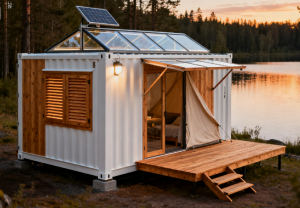
Container homes aren’t “tent replacements”—they create an entirely new accommodation category. This enables you to:
1. Escape price competition traps: Offer unique products that can’t be directly compared
2. Establish new industry standards: Become the definer of upgraded camping experiences
3. Create emotional premium: Customers willingly pay more for unique experiences
Transformation Step 2: Achieve All-Season, All-Weather Operation
Our container camping units are specifically designed to ensure:
- Cool in summer, warm in winter
- Withstand 100km/h winds and heavy rainfall
This means your operating season can expand from 120 days to 365 days annually.
Transformation Step 3: Dramatically Reduce Operational Costs
Maintenance cost comparison analysis:
- Traditional premium tent: Annual maintenance cost = $350-$500/unit
- Container camping unit: Annual maintenance cost = $80-$120/unit
Labor optimization:
- Tent cleaning/setup time: Average 45 minutes/unit/customer turnover
- Container unit preparation time: Average 12 minutes/unit/customer turnover
Transformation Step 4: Multiple Revenue Stream Innovation
Container units’ unique advantages open new revenue sources:
1. Price tiering capability:
- Basic package: Traditional tent areas
- Upgrade package: Standard container units
2. Off-season revenue security:
- Winter “Warm Wilderness” packages
- Rainy season “Dry Adventure” packages
Transformation Step 5: Marketing & Communication Advantages
Container camping units naturally generate buzz:
- 300% higher social media sharing rate than traditional tents
- Average customer stay extended by 1.8 nights
You’re not selling accommodation—you’re selling share-worthy experiences.
ROI Analysis: From Cost Center to Profit Engine
Case Study: Pine Lake Campground Transformation
Before transformation (traditional tent operation):
- Annual occupancy rate: 62%
- Average nightly rate: $45
After transformation (introduced 20 container units):
- Annual occupancy rate: 88%
- Average nightly rate: $129
- Annual accommodation revenue: $367,000
Investment payback period: 14 months
Your Potential Earnings Calculation:
Based on industry averages, each added container camping unit generates:
- Annual direct revenue increase: $8,500 – $12,000
Annual revenue impact of 20 units: $170,000 – $240,000
Success Stories: Leading Campground Transformations
Case One:
Wilderness Light Campground (Wyoming)
Challenge:
Significant seasonality, winter closures, premium client attrition
Solution:
Deployed 15 all-season container units
Results:
- Year-round operation with 68% winter occupancy
- Average daily rate increased from $55 to $145
Case Two:
Shoreline Camping Resort (Oregon)
Challenge:
High cancellation rates (especially during rainy seasons), concentrated customer complaints
Solution:
Gradually replaced 40% of tent inventory with container units
Results:
- Rainy season cancellation rate dropped from 45% to 8%
- Customer satisfaction improved from 3.4/5% to 4.6/5%
Your Seamless Transformation Pathway
Stage One: Pilot Validation (1-3 months)
- Deploy 3-5 pilot units
- Test market demand and pricing elasticity
Stage Two: Strategic Expansion (4-12 months)
- Optimize unit configurations based on data
- Expand to 15-25 units
Stage Three: Complete Transformation (13-24 months)
- Gradually replace low-satisfaction tent areas
- Create brand-exclusive accommodation experiences
Your competitors might already be reading similar proposals.
While you hesitate, they’re:
- Redefining camping standards in their markets
- Attracting your premium customer segments
Traditional tent limitations are no longer acceptable industry standards—they’re exploitable business opportunities.
[Click Here to Schedule Exclusive Business Consultation →]
Join our 30-minute one-on-one consultation with campground solution experts to receive:
1. Customized profit analysis for your campground
2. Detailed data from industry success cases
Please don’t let “it’s just a tent” thinking limit your campground’s true potential. Today’s decision could define your market position for the next decade.
Post time: Dec-03-2025


