

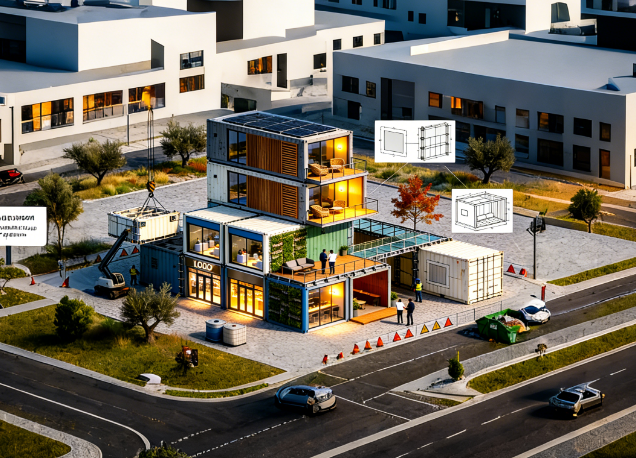
European hotel chain “Urban Oasis” used container modules to build concept hotels in 5 major cities, with an average single-site construction cycle of just 19 weeks — 9 months faster than traditional hotel construction — achieving profitability earlier and delivering 28% annual ROI.
In the current environment where the traditional construction industry faces cost control challenges, unpredictable construction timelines, and increasing sustainability pressures, house containers have become the go-to choice for Western B2B clients seeking breakthrough solutions. For hotel groups, retail chains, educational institutions, and healthcare organizations, house containers represent not only architectural innovation but also strategic tools for responding to market changes, optimizing capital allocation, and enhancing operational flexibility.
01 Four Advantages of House Containers in Addressing Core B2B Pain Points
Precise Cost Control:
68% of traditional commercial construction projects exceed initial budgets, primarily due to material price fluctuations, rising labor costs, and unforeseen on-site issues. House containers utilize factory prefabrication to move 85-90% of the construction process into controlled environments, keeping cost deviations within 3-5%. For B2B clients needing to replicate commercial spaces across multiple locations, this cost predictability significantly improves project cash flow management.
Time Compression and Rapid Market Response:
Traditional commercial buildings typically require 12-24 months from design to delivery, while house container projects can shorten this cycle to 4-9 months. This time advantage translates directly into commercial value — retail brands can enter new markets faster, hotels can begin generating profits 6-11 months earlier, and educational institutions can complete urgently needed teaching space expansions before academic terms begin.
Unparalleled Flexibility:
The modern business environment demands that building assets can adapt to changing business models. The modular nature of house containers enables building spaces to be easily expanded, reduced, reconfigured, or even relocated between sites. This flexibility is particularly valuable for seasonal businesses, market-test retail concepts, and temporary educational or healthcare needs.
Sustainability and Enhanced Brand Value:
As ESG standards increasingly influence corporate decision-making, adopting house containers can significantly boost a company’s environmental credentials. Each repurposed shipping container saves an average of 8,000 pounds of steel and reduces the need for 4,000 pounds of coal required to manufacture new steel. Additionally, house containers generate 70-90% less construction waste than traditional buildings — a compelling statistic for sustainability-conscious B2B clients.
02 Five Application Scenarios for House Containers in Commercial Sectors and ROI Analysis
1. Hospitality and Tourism Accommodation
House containers excel in boutique hotels, resorts, and temporary accommodation facilities. A single 40-foot container can be transformed into a luxury guest room, while multiple container combinations can create complete hotel facilities including lobbies, restaurants, and common areas. Compared to traditional hotel construction, house container hotels average 35-45% lower construction costs and 40-60% shorter investment payback periods.
2. Retail and Dining Spaces
Fast-fashion brands, specialty restaurants, and coffee chains increasingly adopt house containers for pop-up stores or permanent retail spaces. Modular design enables brands to quickly test new market concepts with minimized upfront investment risk. Data shows that house container retail spaces average $125-195 per square foot in construction costs, significantly below the $300-450 range for traditional retail spaces.
3. Educational Institutions and Training Centers
Schools, universities, and training organizations utilize house containers to rapidly add classrooms, laboratories, and administrative spaces. These modular facilities can be quickly deployed during academic breaks without disrupting normal teaching activities. Compared to traditional brick-and-mortar structures, house container educational facilities reduce construction time by 65-75% and lower per-unit-area costs by 30-40%.
4. Medical and Healthcare Facilities
From temporary clinics to specialized treatment centers, house containers provide healthcare organizations with solutions for rapidly expanding service capacity. During the pandemic, several Western hospitals used house container modules to establish isolation wards and testing centers that became operational within 72 hours, demonstrating exceptional emergency response capability.
5. Office and innovation space
Technology companies and creative agencies employ house containers for campus expansions, satellite offices, and collaborative spaces. The modular nature supports on-demand expansion while creating distinctive work environments that help attract and retain talent. Cost analyses reveal that house container office spaces have 22-28% lower annual total costs per square foot compared to traditional office buildings.
03 End-to-End House Container Project Management: From Concept to Operation
Phase 1: Needs Analysis and Feasibility Study (2-3 weeks)
Engage in-depth with B2B clients to clarify business requirements, budget constraints, timing needs, and functional specifications. Conduct site assessments and preliminary compliance checks, providing project feasibility reports and ROI projections.
Phase 2: Custom Design and Engineering Planning (3-4 weeks)
Professional architects and engineers develop customized design solutions balancing aesthetics, functionality, and cost-effectiveness. This phase completes 3D visualization models, detailed construction drawings, and material specification lists, ensuring full compliance with local building codes.
Phase 3: Factory Prefabrication and Quality Control (6-10 weeks)
Perform container cutting, reinforcement, insulation, and pre-installation of electrical and plumbing systems in controlled factory environments. Factory prefabrication enables parallel workflows and stringent quality control, ensuring each module meets uniform high standards while reducing on-site construction uncertainties.
Phase 4: On-site Construction and Module Integration (3-6 weeks)
After completing site preparation and foundation work, transport prefabricated modules to the site for installation, connection, and final assembly. On-site work focuses primarily on foundation engineering and module integration, significantly minimizing disruption to surrounding environments and reducing construction time.
Phase 5: Systems Commissioning and Operational Training (1-2 weeks)
Complete final testing and commissioning of all mechanical, electrical, and plumbing systems, ensuring facilities fully meet commercial operational standards. Provide comprehensive operations manuals and maintenance guidelines, delivering necessary training to client teams.
Phase 6: Post-Completion Support and Maintenance Services (Ongoing)
Offer technical support, regular maintenance services, and potential future modification consultations both during and after warranty periods, ensuring house container facilities maintain optimal condition long-term.
04 Comparative Analysis:
House Containers vs. Traditional Commercial Construction
| Comparison Dimension | Traditional Commercial Building | House Containers | Advantage Comparison |
| Construction Timeline | 12-24 months | 4-9 months | 60-75% shorter |
| Cost Predictability | Average 22% overrun | 3-5% deviation rate | 85-90% improvement |
| Design Flexibility | Fixed structure, high modification costs | Modular, easily adjusted and expanded | 300-400% improvement |
| Sustainability | High resource consumption, significant construction waste | Recycled materials, 70-90% less waste | Significant environmental advantage |
| Location Flexibility | Permanently fixed | Relocatable and reconfigurable | Greatly improved asset utilization |
| Capital Efficiency | High initial investment, long payback period | Lower initial investment, faster returns | 40-60% shorter ROI period |
05 In-depth Analysis of B2B Client Success Cases
Case 1: Multi-City Hotel Rapid Expansion Strategy
A mid-sized hotel group planned to enter 5 new markets within 18 months — a timeline impossible with traditional construction methods. Using house container solutions:
- Completed construction and opening of 5 boutique hotels within 14 months
- Average single-site construction cost: $950,000 (42% lower than traditional hotels)
- First hotel reached break-even 4.3 months after opening
- Group market value increased 67% within 18 months after project completion
Case 2: Educational Institution Responding to Enrollment Fluctuations
An international school faced unpredictable enrollment fluctuations requiring flexible teaching spaces. With house container solution:
- Established 12 expandable classrooms that could be quickly increased or decreased based on
demand
- Classroom modules could be reconfigured within 72 hours
- Saved $2.1 million in initial investment compared to traditional expansion
- Enabled school to admit additional 180 students, increasing annual revenue by $1.08 million
Case 3: Healthcare System Emergency Capacity Building
A hospital group needed enhanced emergency response capabilities with limited budget. Through house container solution:
- Established a network of rapidly deployable mobile medical units
- Each unit could reach any branch location and become operational within 48 hours
- During health crises, these units handled additional 23% of patient volume
- Obtained $1.5 million in emergency preparedness grants from local governments
06 House Container Marketing Strategies for B2B Clients
Establish Industry Authority
- Develop in-depth whitepapers targeting specific industries, such as “The Strategic Value of House Containers in Hotel Chain Expansion” and “Modular Construction Solutions for Educational Space Challenges”
- Showcase success cases at industry conferences and trade exhibitions, emphasizing ROI data and actual operational outcomes
- Establish strategic partnerships with renowned architectural firms, engineering companies, and project management firms
Provide Quantifiable Value Evidence
- Develop interactive ROI calculators allowing potential clients to obtain personalized financial analyses by inputting specific parameters (location, scale, usage type)
- Create a case study library documenting the complete project journey from concept to operation, highlighting key decision points and results data
- Offer side-by-side comparisons with traditional construction using real project data
Optimize B2B Digital Marketing
- Optimize website content for industry-specific search terms like “rapid commercial construction solutions,” “scalable retail spaces,” and “temporary educational facilities”
- Utilize LinkedIn targeted advertising to reach decision-makers in construction, hospitality, retail, and education sectors
- Develop virtual reality presentations enabling potential clients to remotely experience completed projects, especially when international clients cannot visit sites
Build Comprehensive Client Support Systems
- Provide end-to-end support services from initial consultation, design, and construction to post-completion operations
- Establish transparent communication mechanisms with regular project updates, proactively identifying and resolving potential issues
- Offer flexible financing options and leasing alternatives to lower clients’ initial investment thresholds
Cultivate Long-term Client Relationships
- Implement customer success programs ensuring each project not only meets but exceeds client expectations
- Create user communities facilitating experience sharing and best practice exchanges among clients
- Regularly provide industry insights and trend analyses helping clients maximize their house container investment value
Container homes are revolutionizing the game in commercial construction. From cost control and time efficiency to design flexibility and sustainability, this modular solution directly addresses the core challenges faced by modern B2B clients when expanding, upgrading, or adapting to the market.
Your business idea deserves a space that’s just as flexible, efficient, and forward-thinking to carry it. Whether you’re planning to open a new storefront, expand an office park, set up temporary educational facilities, or create a unique hotel experience, container homes can provide you with a tailored solution.
Click here to get the detailed Container Home Commercial Application Solutions made specifically for your business and schedule a free consultation with our expert team. Let’s turn your efficient space idea into reality together.
Post time: Dec-08-2025


