

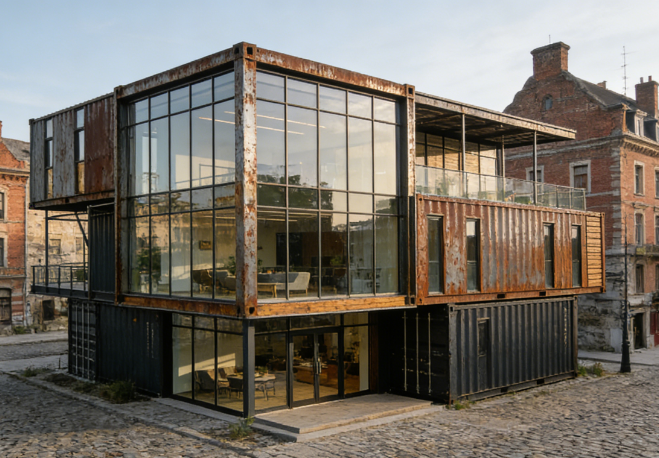
The owner of a hotel in Iceland stands in the lobby of his newly opened, high-end hotel. The modular building before him harmoniously coexists with the distant snow-capped mountains. This was already his second order from the same Chinese manufacturer.·
The core driving force of Modern architecture has always been to address the most pressing challenges of the era. Today, that challenge is to deliver high-quality, customizable living and commercial spaces that meet stringent standards for the European and American markets in a shorter time frame and in a more sustainable way. Container modular construction is no longer an alternative but a forward-thinking business choice that fulfills these modern demands.
1.Market Opportunity: Why Modular Construction is Reshaping the Building Industry in Europe and America
The construction markets in Europe and America are at a critical inflection point. On one hand, traditional building methods are constrained by skyrocketing labor costs, uncontrollable project delays, and increasingly stringent environmental regulations. On the other hand, societal demand for affordable housing and rapidly deployable commercial space continues to climb.
This creates a significant market window for container modular construction. According to industry reports, the European market is projected to be the fastest-growing region globally. The market drivers are clear: Germany already has a prefabricated building stock as high as 23%, and companies in places like the UK are investing heavily in super factories capable of producing one housing unit per hour.
In the commercial sector, projects such as hotels, student apartments, and emergency housing, which prioritize speed and certainty, are elevating modular construction from an “option” to the “preferred option.” The core reason an Icelandic hotel owner chose to repurchase was that modular construction enabled him to commence operations rapidly, shortening a construction cycle that traditionally takes years to just a few months.
2.Core Advantages: Defining the Value Standards of a New Generation of Modern Architecture
For B2B clients seeking reliability and efficiency, the value of container modular construction is manifested in four quantifiable dimensions, forming the cornerstone of value for a new generation of Modern architecture.
Speed and Certainty: This is the most immediate business advantage. A prefabrication rate of up to 95% in the factory means on-site construction is minimally affected by uncertainties like weather and labor shortages. For an Ibis hotel project in Perth, Australia, 252 modules were manufactured in China, shipped, and assembled locally, achieving delivery in just 4 months, compared to at least two years for traditional methods.
Cost and Quality Control: Factory-based assembly line production brings economies of scale and consistent quality control. All modules are completed with main finishes and pre-installed utilities before leaving the factory, making per-unit construction costs more predictable and quality far superior to fragmented on-site work.
Sustainability and Environmental Protection: A social responsibility that Modern architecture must fulfill. The modular construction method can reduce construction waste by over 50% and significantly lower on-site pollution. The steel frame has a recycling rate exceeding 90%, aligning with the strict circular economy requirements of the European market.
Flexibility and Scalability: Modern business requires buildings that can adapt to future development. The standardized nature of container modules allows buildings to be combined and expanded like Lego. Whether it’s a small boutique hotel initially or a large-scale resort expansion later, it offers a flexible solution.
3.Customization Capability: Meeting the Demands of High-End Markets and Harsh Environments in Europe and America
A true Modern architecture solution must possess the capability to deeply adapt to different market regulations and physical environments. This is not just a technical issue but also a reflection of a deep understanding of client needs.
In Europe, modular building designs must strictly adhere to EU Building Regulations. Successful suppliers are already capable of offering standard products for permanent buildings with a service life of up to 50 years.
To address diverse climates and geographical environments, high-end customization has become a competitive threshold:
Nordic Market: Requires modules to pass extreme cold resistance tests at -30°C, with the container body maintaining high airtightness standards to withstand severe cold and snowstorms.
Southern Europe and Coastal Areas: Focus on corrosion resistance performance; surface coatings need to pass over 1000 hours of salt spray testing to withstand the Mediterranean climate.
Environmental Pioneer Markets (e.g., Germany, France): Integrated designs incorporating solar PV power supply and intelligent temperature control systems are increasingly becoming standard, responding to the EU’s 2030 climate targets.
These proven customization capabilities mean your project can bypass the need to overcome technical barriers from scratch and directly access mature, reliable solutions.
4.Success Stories: The Validated Path from Concept to Operation
Commercial trust is built on validated success. The field of modular construction is already rich with global benchmark projects that demonstrate its ability to tackle complex challenges.
One of the world’s largest modular student dormitories, the City University of Hong Kong’s Lee Shau Kee Student Residence Village, showcases the application of modular construction in large-scale, high-density projects. In Europe and America, high-end hotel projects have become an excellent showcase for modular construction.
The Courtyard by Marriott project in Iceland is a classic case study. After 78 building modules were delivered to the site, hoisting and installation were completed in just 9 days, allowing for rapid commissioning. It was precisely this astounding efficiency and reliable quality that prompted the client to sign a contract for a new project recently, achieving a repeat purchase.
The first modular construction hotel project in the Middle East—the Earth Boutique Hotel in Riyadh, Saudi Arabia—indicates the significant potential of this technology in high-growth emerging markets. These cases collectively outline a clear path: from standardized production, to cross-ocean transportation, culminating in a rapid transformation into a high-end commercial space at the destination.
5.Partner Selection: Co-creating End-to-End Value Beyond a Supplier
Choosing container modular construction is not just about procuring a product; it’s about selecting a long-term partner who can share risks and co-create value. An excellent partner should possess the following core competencies:
Integrated Delivery Model: An ideal partner should offer integrated REMPC (Research, Engineering, Manufacturing, Procurement, Construction) services. This model consolidates the fragmented responsibilities of traditional construction under one entity, ensuring seamless connection across all project phases.
Global Operation and Compliance Experience: The supplier must possess mature international logistics capabilities and a profound understanding of the building regulations in destination countries. For instance, leveraging its group’s global network in container and transportation, CIMC Modular Building Systems ensures modules safely and efficiently reach over 20 countries and regions worldwide.
Technology R&D and Patent Support: Continuous product upgrades stem from robust R&D. Leading companies possess dozens of independent patents, such as foldable container technology for overseas markets, which can reduce transportation space by 80%, significantly lowering logistics costs.
—
While developers in Europe are anxious about project delays and budget overruns, the Ibis hotel in Perth is already welcoming guests. While owners in North America worry about whether their buildings comply with the latest green subsidy policies, modular apartments equipped with photovoltaic roofs are already saving energy costs for residents.
Choosing container modular construction is choosing a future of certainty, validated by global high-end projects. This is not only about the building itself but also about your capital efficiency, brand reputation, and ability to seize market opportunities. The evolution of Modern architecture is already happening; it is being quietly prefabricated in factories, waiting to bloom rapidly across the globe.
Click here to get your exclusive solution for Modern architecture!
Post time: Dec-17-2025


