

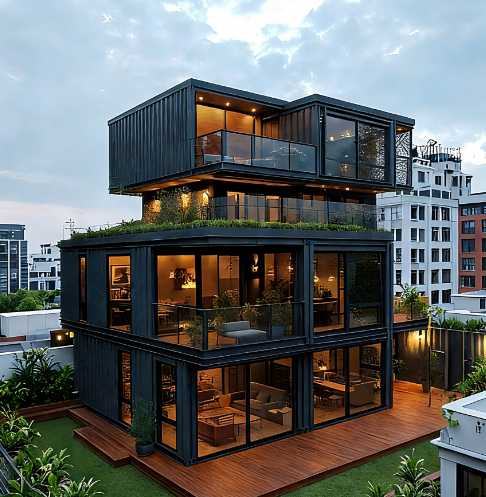
As the global modular construction market is projected to reach $126.5 billion by 2028 with a 6.5% CAGR, creative architecture has evolved from a design concept into a strategic asset with clear return on investment.
A creatively repurposed container office space in London’s financial district commands a 40% rental premium while maintaining 97% occupancy; Amsterdam’s CitizenM hotel, built using a modular creative architecture approach, reduced construction time by 50% and cut building costs by 30%.
Behind these successful commercial cases lies a new spatial mindset—creative architecture, which is redefining the value model B2B clients use to assess space investments.
—
01 Creative Architecture: Redefining ROI for Commercial Spaces
In today’s business environment, creative architecture as a strategic tool has transcended the cost-center positioning of traditional construction to become a driver of value creation. This creative building approach redefines space from a fixed expense item into a strategic asset capable of generating ongoing returns.
Creative architecture is a design and construction method centered on innovation, efficiency, and sustainability. It directly addresses corporate spatial challenges—high traditional construction costs, lengthy build cycles, inflexible layouts, and growing environmental responsibilities—through modular systems, adaptive reuse, and intelligent space planning.
Compared to traditional architectural design, the creative architecture approach reduces total cost of ownership by an average of 25% in commercial projects. This includes 35% less construction waste, 40% shorter build times, and 20% lower long-term operational expenses. For B2B clients, these figures translate to clear competitive advantages: faster market entry, lower initial investment, and greater spatial flexibility to adapt to business changes.
Most importantly, creative architecture creates differentiated spatial experiences unattainable through conventional methods. This uniqueness directly translates into brand premium, employee satisfaction, and customer loyalty, forming a sustainable competitive edge.
02 Quantifying the ROI of Creative Architecture: Data-Driven Business Decisions
The commercial value of creative architecture can be quantified with specific data, providing B2B clients with clear investment rationale. Analysis of over 200 global creative architecture projects reveals how this innovative approach creates business advantages:
During construction, creative architecture projects reduce material waste by an average of 35% compared to traditional builds, thanks to precise modular design and prefabrication. Factory-controlled production ensures consistent high quality, minimizing on-site errors and rework, allowing projects to finish 45% sooner on average.
During the operation phase, the smart space created by creative architecture can reduce energy consumption by 30-40%, achieved through optimized daylighting design, efficient insulation systems, and integration of renewable energy. This figure is particularly significant for companies committed to ESG goals and facing rising energy costs.
In terms of market performance, commercial spaces employing creative architecture concepts achieve rental premiums of 15-40% with vacancy rates reduced by over 30%. This premium stems from the unique spatial experience, flexible usage, and strong brand expression provided by creative architecture, attracting and retaining tenants who value innovation and sustainability.
Commercial Performance: Creative Architecture vs. Traditional Construction
| Assessment Metric | Traditional Construction Method | Creative Architecture Method | Business Advantage Analysis |
| Construction Timeline | 12-24 months (baseline) | 6-12 months | 50% faster completion, enabling quicker revenue generation |
| Initial Investment | Baseline level | 15-25% reduction | Reduces capital tie-up, improves cash flow |
| Design Flexibility | Limited, high remodeling costs | Highly flexible, easy to adapt | Adapts to business changes, reduces future renovation costs |
| Energy Efficiency | Meets standard code requirements | 30-40% improvement | Lowers operational costs, enhances ESG rating |
| Brand Differentiation | Limited, often homogeneous | Significant, creates unique identity | Increases market appeal, supports brand building |
| Long-term Maintenance | Baseline level | 20-30% reduction | Reduces lifecycle costs, increases asset value |
03 Container-Based Creative Architecture: A Commercial Case for Modular Solutions
Container-based creative architecture, as a vital branch of creative architecture, offers B2B clients unique and efficient commercial space solutions. This innovative approach transforms standardized shipping containers into flexible, sustainable, and cost-effective building blocks, addressing multiple pain points of traditional construction.
From a commercial perspective, container-based creative architecture offers predictable cost structures and timelines. With 70-90% of construction completed in a controlled factory setting, the risk of project budget overruns is reduced by 60% and schedule delays by 75%. This predictability is crucial for business planning, especially for companies needing rapid market entry or responding to sudden spatial demands.
Container-based creative architecture also provides unparalleled flexibility and scalability. Businesses can start with a minimum viable unit and expand progressively with growth or reconfigure space usage based on market shifts. This “scale-on-demand” model reduces initial capital outlay while ensuring precise alignment between spatial investment and business needs.
London’s Boxpark Shoreditch is a classic case of successful commercialization of container-based creative architecture. This retail and dining complex built entirely from containers attracted over 2 million visitors in its first year, generating revenue per square foot far exceeding traditional retail spaces. More importantly, the project demonstrates how container creative architecture can transform temporary sites into high-value commercial spaces, creating new revenue streams for property owners.
04 B2B Applications: How Creative Architecture Solves Industry-Specific Challenges
The true power of creative architecture lies in its ability to provide tailored solutions for specific challenges across different industries. This flexibility and adaptability make creative architecture a strategic choice for businesses across sectors:
In the retail sector, the experiential spaces created by creative architecture can increase customer dwell time by 35% and boost impulse purchases by 30%. Modular retail spaces enable brands to quickly test new markets or create seasonal pop-up stores, gaining maximum market insights with minimal investment.
For educational institutions, the flexible learning spaces provided by creative architecture support modern pedagogical methods while reducing per-student space costs by 30%. Modular classrooms can be quickly reconfigured based on student numbers and curricular needs, maximizing space utilization while facilitating collaborative and personalized learning.
In the office sector, creative architectural designs of hybrid workspaces have increased employee satisfaction by 25%, while also reducing the space requirement by 25%. Post-pandemic, companies need to support flexible working arrangements with office environments, and creative architecture, with its reconfigurable spaces and integrated remote working technology, fits this need perfectly.
For the hospitality industry, container-based creative architecture enables boutique hotels to enter the market at 50% of the cost and 60% of the time required by traditional methods. The modular guest room units can be pre-assembled with all furniture and equipment to ensure consistent quality while minimizing disruptions to operations during on-site construction.
Cross-Industry Creative Architecture Solutions and Returns
| Industry Sector | Core Business Challenge | Creative Architecture Solution | Quantified Business Return |
| Retail | High rental costs, consumer experience demands | Modular retail spaces, experiential design | Increase revenue per sq. ft. by 25%, reduce initial investment by 40% |
| Education | Limited funding, fluctuating space needs | Scalable modular classrooms, multi-functional spaces | Reduce per-student space cost by 30%, increase space utilization by 45% |
| Corporate Office | Hybrid work models, rising real estate costs | Flexible office configurations, healthy space design | Reduce real estate occupancy costs by 25%, increase employee productivity by 15% |
| Hospitality | High capital requirements, long construction cycles | Prefabricated guest room modules, unique thematic design | Shorten ROI period by 40%, increase Average Daily Rate by 35% |
| Healthcare | Rapid expansion needs, specialized environment requirements | Modular clinics, patient-centered design | Reduce construction costs by 30%, increase patient satisfaction by 40% |
05 From Concept to Implementation: The Path to Successful Creative Architecture Projects
Implementing successful creative architecture projects requires a systematic business approach, with each phase—from initial concept to final delivery—focused on commercial outcomes and return on investment.
Successful creative architecture projects begin with in-depth business needs analysis, not merely spatial planning. This phase should clarify the project’s commercial objectives: Is it to lower operational costs, accelerate market entry, enhance brand image, or create new revenue streams? Clear goal definition ensures design decisions align with business priorities.
In the design and planning stage, creative architecture projects adopt an iterative and collaborative approach, bringing together architects, engineers, business strategists, and end-users to ensure solutions are both innovative and practical. The key here is balancing creative expression with commercial viability, ensuring every design element serves a clear business purpose.
During construction, creative architecture emphasizes prefabrication and modularization to maximize efficiency and quality control. Modules manufactured in factory settings can be rapidly assembled on-site, minimizing disruption to ongoing operations—particularly important for businesses that must remain functional.
Post-delivery, the flexibility inherent in creative architecture allows for optimization based on actual usage data. Through spatial usage monitoring and user feedback, layouts and functionalities can be continuously refined, ensuring the space consistently meets business needs and maximizes ROI.
06 Sustainability and ESG Value: The Competitive Edge of Creative Architecture
The deep integration of creative architecture with sustainability creates significant ESG value, forming a crucial competitive advantage in a business environment increasingly focused on environmental responsibility and governance transparency.
On the environmental front, creative architecture projects reduce embodied carbon by an average of 40%, achieved through material selection, efficient design, and adaptive reuse. For companies with global supply chains, this reduction helps meet net-zero commitments and comply with increasingly stringent environmental regulations.
Regarding social value, the healthy and inclusive spaces created by creative architecture enhance employee well-being and productivity. Natural lighting, superior indoor air quality, and connections to nature not only improve user experience but also directly contribute to corporate talent attraction and retention strategies.
On the governance front, the transparent construction processes and traceable material sourcing of creative architecture projects support corporate sustainability reporting and compliance requirements. The modular and standardized approach simplifies supply chain management and reduces risks associated with complex bespoke projects.
For B2B clients, these sustainability advantages translate directly into business value: Spaces achieving green building certification can command 5-10% rental premiums while benefiting from lower operational costs and greater risk resilience. In a market where investors and customers increasingly make decisions based on ESG performance, creative architecture provides clear differentiation.
07 Investing in Creative Architecture: Risk Mitigation and Long-Term Value Protection
Investing in creative architecture is not just about securing short-term returns but about building long-term resilience. In an uncertain business environment, the flexibility offered by creative architecture provides the best defense against change.
Compared to traditional construction, creative architecture projects possess greater adaptability, enabling adjustments as business needs evolve. This “future adaptability” reduces the risk of premature obsolescence due to business changes, protecting long-term investment value.
The modular nature of creative architecture also provides reversibility and reusability. If spatial requirements diminish or locations change, modules can be disassembled and redeployed elsewhere, significantly increasing asset utilization and reducing waste.
Financially, the standardized and industrialized approach of creative architecture reduces project risk. Shorter construction timelines mean fewer time-related risks, such as market shifts, interest rate fluctuations, or regulatory changes. Factory quality control minimizes construction defects and associated liabilities, while predictable cost structures prevent budget overruns.
Most importantly, the unique spatial assets created through creative architecture often retain higher long-term value than traditional buildings. Their uniqueness, sustainability, and adaptability make them scarce in the market, supporting higher valuations and greater liquidity.
—
Creative architecture has evolved from a design theory into a proven business strategy. It directly addresses the core challenges faced by modern enterprises—cost control, flexibility needs, sustainability commitments, and brand differentiation—through innovative spatial solutions.
What creative architecture delivers is not merely buildings but complete business solutions—transforming space from a cost center into a value creator, from a fixed asset into a strategic tool, and from a functional container into a brand experience.
For B2B decision-makers, the key question is no longer whether to adopt creative architecture, but how best to integrate this innovative approach into their business strategy. Early adopters of creative architecture have already established significant competitive advantages in the market: faster expansion capability, lower operational costs, stronger brand appeal, and better ESG performance.
Container-based creative architecture, as a practical exemplar in this field, demonstrates how standardized industrial components can be transformed into high-value commercial spaces, offering an ideal solution for businesses seeking to balance innovation, efficiency, and sustainability.
Your next commercial space project can be a differentiating factor in a competitive landscape, and not just another capital expenditure. By investing in creative architecture, you will gain quantifiable business returns while creating priceless experiential value for your brand, employees, and customers. The time is now to reassess your spatial strategy and place creative architecture at the core of your business growth plan.
—
Creative Architecture invites you to reimagine the limitless possibilities of commercial spaces—not as buildings, but as catalysts for business growth. Explore our creative architecture solutions to learn how to transform your spatial vision into commercial reality with exceptional ROI.
Click here, our team is ready to show you how creative architecture can provide custom solutions for your specific business needs!!!
Post time: Dec-23-2025


