

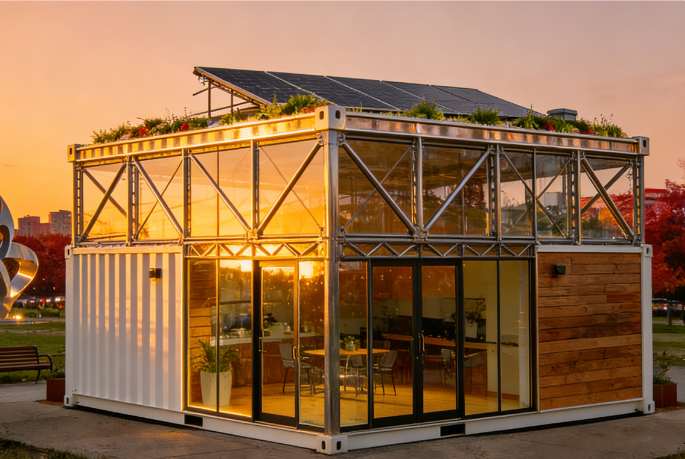
Dear Decision-Maker, when you see the term “temporary building,” do you associate it with cost, compromise, or opportunity? We propose a shift in mindset: consider modern container modular buildings as “strategic hardware” in your enterprise infrastructure—rapidly deployable, flexibly configurable, and capable of generating measurable ROI. This is not wordplay, but an efficiency revolution in capital, time, and space management.
Chapter 1: Financial Perspective – The Clear Evolution from “Cost Black Hole” to “Asset Map”
The financial nature of traditional temporary buildings (e.g., site cabins) is that of a consumable. Its cost model is simple yet concealed: Initial Purchase Cost + Ongoing Maintenance Cost + Zero Residual Value = Silent Net Outflow.
In contrast, the financial model of container modular buildings is a dynamic, planable asset investment:
1. Predictability of Initial Investment: A “Space Product” Contract with Locked-in Pricing
Specific Breakdown: Your investment is clearly allocated to: A) Code-compliant steel structure; B) High-performance insulation wall systems (e.g., rock wool fill, U-value as low as 0.28 W/(m²·K)); C) Pre-integrated MEP (Mechanical, Electrical, Plumbing) systems; D) Finished interior交付. All completed in-factory, with prices locked at contract signing, immune to raw material price fluctuations during construction.
2. Cash Flow Advantage During Holding Period: Speed Creates Revenue
Specific Comparison: A 2,000 square meters temporary storage facility. A traditional approach (design, permitting, construction) may take 5-6 months to become operational. The container modular solution, from design finalization to on-site delivery, can be shortened to 8-10 weeks. This means your business can start operations 3-4 months earlier, generating cash flow. Assuming this storage can save or generate $50,000 in value per month for the business, then the “time value” alone equates to an additional $150,000 – $200,000 in implicit revenue.
3. Asset Disposal at End of life cycle: Residual Value Realization & Green Credit
Specific Paths: At the end of the project cycle (e.g., 3 years), your options are not demolition but: A) Whole-site Relocation to a new project site, incurring only transportation and minor refurbishment costs (~15-25% of initial investment); B) Resale, with an active secondary market for modular buildings ensuring residual value (typically 50-70% of initial investment); C) Functional Conversion, e.g., transforming office modules into dormitories or showrooms, extending asset life. This not only recovers costs but also turns the “recyclable” nature itself into a green credit within modern supply chains.
Chapter 2: Operational Depth – Demystifying the Systematic Delivery Behind “Plug-and-Play” Space
“Rapid deployment” is not magic, but a precise industrial process. Here is the deterministic timeline you will receive:
Weeks 1-3: Parallel Design & Permitting
Specific Work: Our engineers collaborate with your team using BIM (Building Information Modeling) to complete all module design, MEP clash detection, and performance simulation in a virtual space. Simultaneously, because standardized modular units comply with international codes, the permitting process is significantly simplified and accelerated due to its predictability.
Weeks 4-8: Factory-Based Parallel Production
Specific Scenario: While your site is undergoing grading and foundation work, your building is being born simultaneously on multiple factory assembly lines: one for structural reinforcement and painting, another for wall panel and window installation, a third for interior finishing and fixture installation. This parallel engineering is the core of timeline compression. Each module undergoes complete system testing before leaving the factory.
Weeks 9-10: On-Site Craning & System Commissioning
Specific Process: Prefabricated modules arrive on-site in sequence and are precisely craned into place like building blocks. The key lies in the “quick connectors”—pre-installed utility interfaces on the modules that enable the connection of the entire building’s systems within hours. Final commissioning and key handover occur within a week.
Chapter 3: Strategic Scenarios – Injecting Flexibility and Sustainability into Core Business
Scenario A: The “Mobile Fortress” for Large-Scale Infrastructure EPC Contractors
Specific Pain Point: During a three-year cross-border railway project, command centers are needed at multiple remote sections along the route. Traditional site cabins offer poor comfort, high relocation damage, a subpar image, and each setup takes 2-3 months, delaying the schedule.
Specific Container Solution Configuration: Deploy a relocatable headquarters cluster composed of twenty 40ft high-cube containers. This includes: 6 Command & Office Modules (with private offices, meeting rooms, data centers); 8 High-Standard Living Quarter Modules (with en-suite bathrooms, AC); 4 Dining & Recreation Modules; 2 Equipment Storage Modules. Upon project completion, all modules can be packed and transported via multimodal logistics to a new project in another country, achieving global asset circulation.
Scenario B: The “Vanguard Retail Lab” for Premium Consumer Brands
Specific Pain Point: Planning a limited pop-up tour in five key North American cities to test market response. Each location lease is only 2 months. Traditional fit-outs are long (at least 1.5 months), costs are uncontrollable, and construction waste contradicts the brand’s sustainability ethos.
Specific Container Solution Configuration: Customize two highly-designed Flagship Display Containers. Exteriors feature custom cladding and digital signage systems; interiors are fully integrated with lighting, audio, interactive screens, and product display systems. They are complete “brand capsules.” While the first is exhibited in New York, the second is being produced in parallel at the factory. After New York, modules are trucked to Chicago, while the third module is dispatched. This creates a rolling rhythm of “exhibition-transportation-preparation,” ensuring absolute consistency in brand image and maximum speed of deployment.
Chapter 4: Sustainability Decoded – From Compliance Cost to Value Creation
By choosing container construction, you are investing in a quantifiable green asset:
1. Carbon Credit from Material Circularity:
Each container used is equivalent to saving approximately 3,500 kg of steel and the corresponding 8,000 kg of CO2 emissions from the full process of smelting scrap steel, rolling, and manufacturing new structures. This is a clear deduction in corporate carbon accounting.
2. Zero Waste in Construction Process:
Factory production increases material utilization to over 99%, reducing on-site construction waste by more than 95%. This not only saves waste removal costs but also avoids potential environmental fines and directly contributes to high scores in green building certifications like LEED/BREEAM.
3. Ongoing Savings in Operational Energy:
High-performance building envelopes and Integrated solar roofs can reduce the operational energy consumption of such buildings by 40-60% compared to traditional temporary structures. This translates to annually recurring reductions in energy bills and operational carbon footprint.
—
Conclusion:
The era of temporary buildings is over. Welcome to the era of “Deployable architecture..” Here, space is a strategic node whose ROI you can calculate precisely, configure freely to adapt to business flow, and move across a global map. It unbinds business from geography, transforms fixed assets into dynamic ones, and turns environmental responsibility into a competitive asset.
This is not merely about purchasing a building; it is about equipping your enterprise with a future-oriented core capability.
Contact us to initiate your first strategic deployment project.
Post time: Dec-10-2025


