

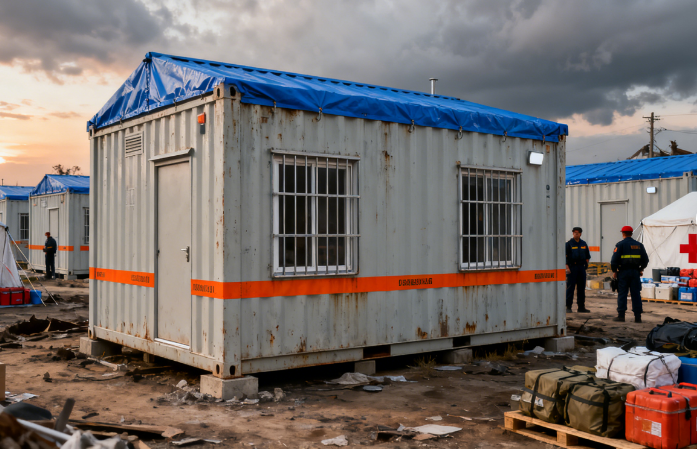
In an era where natural disasters seem to be increasingly frequent and devastating, the urgent need for effective emergency shelter solutions has never been more apparent. When earthquakes level cities, hurricanes destroy communities, or floods force mass evacuations, the immediate challenge becomes: where will survivors live while recovery efforts unfold? Traditional solutions often fall short—tents offer limited protection from extreme weather, hotel rooms become rapidly overwhelmed, and conventional construction takes far too long. This is where the Disaster Relief Container House emerges as a game-changing solution, blending durability, rapid deployment, and human dignity in times of unprecedented crisis.
The Growing Global Need for Emergency Shelter
Recent years have painted a stark picture of our world’s vulnerability to disasters. Turkey’s catastrophic 2023 earthquakes left hundreds of thousands homeless, with reports indicating that over 70,000 residents in Kahramanmaraş province alone were still living in “container cities” a full year after the disaster. Similarly, when a 6.2-magnitude earthquake struck China’s Gansu province, container-style color steel plate houses were rapidly deployed to create emergency settlements .
The global landscape of displacement—driven by conflicts, climate events, and natural disasters—has pushed governments and humanitarian organizations to seek more effective shelter solutions. The European Union recognized this pressing need by allocating €116.6 million to develop emergency shelter reserves across multiple countries, specifically including “light prefabricated structures, flat-pack containers and emergency tents” among their key resources . This significant investment underscores the crucial role that pre-planned, deployable shelter solutions play in modern disaster response.
What is a Disaster Relief Container House?
A Disaster Relief Container House represents a revolutionary approach to emergency accommodation. These are not merely repurposed shipping containers, but rather specially engineered living spaces designed specifically for disaster scenarios. Unlike traditional tents or makeshift shelters, these container houses offer secure, weather-resistant environments that can be rapidly deployed where need is greatest.
The fundamental advantage of these structures lies in their balanced approach to temporariness. While intended as emergency solutions, they recognize that recovery often takes years, not months. As the UNHCR emphasizes, “single-family accommodation is always preferable to collective accommodation because it provides the necessary privacy, psychological comfort, and sense of security” . The Disaster Relief Container House delivers precisely this: individual family spaces that maintain dignity during displacement.
Key Advantages of Container-Based Shelter Solutions
Rapid Deployment and Scalability
When disaster strikes, speed saves lives. The Disaster Relief Container House excels in this critical dimension. Designed for quick transportation and assembly, these units can be shipping to affected regions and made habitable within hours, not weeks. Their modular nature allows for the creation of entire settlements complete with essential facilities. The EU’s rescEU program specifically highlights this “rapid deployment” capability as essential for effective emergency response .
Exceptional Durability and Protection
Unlike temporary tents that offer limited protection from elements, the Disaster Relief Container House provides robust shelter against extreme weather conditions. These structures are engineered to withstand challenging environments, with advanced prototypes like FEMA’s SEED unit designed to meet codes for “seismic risk zone II in Hawaii and 195 mph winds in Guam” . This resilience ensures safety in the most demanding post-disaster scenarios.
Privacy and Dignity in Crisis
Perhaps the most overlooked yet crucial advantage is the privacy these containers afford displaced families. While collective centers or camps often force multiple families into shared spaces, each Disaster Relief Container House provides individual family units with locking doors and separate living areas. This preserves dignity during incredibly challenging times and aligns with UNHCR standards that emphasize “privacy, dignity, comfort, and safety” .
Environmental Considerations
Modern Disaster Relief Container House designs increasingly prioritize sustainability. The EU’s program highlights environmental considerations including “reducing waste, minimizing transport… choosing recycled or reusable materials” and incorporating “solar panels and efficient generators” . Some designs even feature water purification systems to reduce bottled water dependency—a significant innovation in resource-constrained environments.
Critical Design Considerations for Effective Disaster Shelter
Cultural and Climatic Adaptation
A one-size-fits-all approach fails in global disaster response. The Disaster Relief Container House must be adapted to local climates and cultural norms. UNHCR guidelines specify different space requirements for warm climates (minimum 3.5m² per person) versus cold climates (4.5-5.5m² per person) . Similarly, designs must consider whether cooking typically occurs indoors or outdoors, privacy requirements, and family structure norms in affected communities.
Accessibility for Vulnerable Populations
True effectiveness of any emergency shelter solution is measured by how it serves the most vulnerable. The EU’s program mandates that “20% of the units as well as the communal spaces have been designed for people with mobility problems or disabilities” . This proactive approach to accessibility ensures that Disaster Relief Container House settlements don’t exclude those with special needs.
From Temporary to Transitional
The most successful container housing designs acknowledge that “temporary” solutions often become long-term realities. The FEMA SEED project exemplifies this principle with its “temp-to-perm” approach, where “the unit unfolds to twice its shipping size to become a small ADA accessible home, designed to operate off-grid or on-grid” while potentially expanding into permanent housing . This forward-thinking design breaks the problematic cycle of emergency-temporary-permanent reconstruction.
Learning from Past Challenges
It’s important to acknowledge that modular emergency housing has faced criticisms that inform today’s improved Disaster Relief Container House designs. Past examples from the UK showed container housing initially welcomed as innovation later being criticized as “shipping container hell” when residents reported units becoming “very hot in the summer and cold in the winter” . The lesson is clear: proper insulation and climate control are non-negotiable for dignified shelter.
Similarly, the challenge of “temporariness becoming long-term” must be addressed through designs that remain viable beyond short-term use. The Disaster Relief Container House of today incorporates these hard-learned lessons with improved insulation, ventilation systems, and more adaptable designs.
The Future of Disaster Relief Housing
Innovation in Disaster Relief Container House technology continues to advance. Researchers are exploring 3D-printed concrete blocks for faster assembly , while companies are developing increasingly sophisticated flat-pack designs that minimize shipping volume and costs. The growing prefabricated emergency shelter market—projected to reach significant capacity by 2031 —indicates increasing investment and innovation in this sector.
The integration of smart technologies, renewable energy systems, and more culturally sensitive designs promises even more effective Disaster Relief Container House solutions in the coming years. The focus is shifting toward creating settlements, not just shelters—communities where recovery can genuinely take root.
Conclusion: Beyond Basic Shelter
The Disaster Relief Container House represents far more than just emergency accommodation. It embodies a commitment to preserving human dignity when people have lost everything. By providing secure, private, and adaptable living spaces during the most challenging periods of displacement, these innovative structures become catalysts for recovery—places where children can do homework, families can share meals, and communities can begin rebuilding.
As disaster response evolves to meet growing global challenges, the Disaster Relief Container House stands as a testament to what’s possible when innovation meets compassion. For governments, aid organizations, and communities seeking to enhance their disaster preparedness, these modular housing solutions offer a practical, scalable, and humane answer to one of crisis’s most fundamental questions: where will people call home when disaster takes everything?
Click here to get the latest design of Disaster Relief Container House
Post time: Nov-26-2025


